Introduction
Have you ever noticed that you watched a completely random Reel, didn’t like it, comment on it, or follow the profile - you just watched it and skipped it? But after some time, your entire feed is filled with similar content.
How does that happen?
And how can clicking on just one notification end up wasting hours of your time without you even realizing what you’re doing?
Let’s take a look at what Meta says about its prediction algorithm:
The prediction models of an AI system may use information such as the features of posts and a person’s history of interacting with similar posts when making predictions about levels of interest. There are thousands of these signals used across Facebook and Instagram.
For example, when predicting how likely it is that a person will engage with a post, AI systems consider signals such as:
- How many likes, comments, and views a post or video has received
- How often or how long a person watches videos or views posts
- How a person interacts with a given author, such as how many times they have seen and liked similar posts from that person
How this feedback loop works:
Mobile gives algorithm richer signals
Have you ever noticed that Instagram’s mobile app seems to recommend Reels better than its browser version?
Here are some of the signals it can observe on mobile:
- Watch Time Tracking: On the mobile app, Instagram can track how long you watch a Reel and how you interact with it. The browser can also track watch time, but the mobile app has access to additional device-level signals and interactions.
- Sensors and Gestures: I noticed that when I rotate my phone while watching Reels, the recommendations sometimes start changing. On mobile, Instagram can also observe interactions such as swipes, taps, and device orientation. On a browser, the available signals are different - mostly mouse clicks, scrolling, keyboard input, and trackpad interactions.
This doesn’t mean that Instagram can’t track your behavior on the web. It can. The difference is that mobile provides a richer set of behavioral signals, which can give the recommendation system more information about your interests.
How They Filter Billions of Reels to Serve You One
First, Instagram starts by collecting data about the user. That includes likes, shares, how much time you spend on a specific Reel, who you follow, and more.
It categorizes videos based on content type, genre, audio used, visual elements, and more.
It then creates a digital profile of your preferences and engagement history. This profile evolves over time.
Real-time adaptation: It adapts as you browse and interact with content.
There are multiple stages where Instagram ranks and filters content.
The first stage is the retrieval stage, where Instagram narrows down thousands of Reels to a few hundred relevant candidates. It uses ML models and other methods to predict which Reels a user may like.
It also looks at the user’s past interactions, such as likes, saves, and shares, to find similar Reels. Irrelevant or low-quality Reels are filtered out before moving to the next stage.
Ranking Stages
After selecting a few hundred Reels, Instagram ranks them to find which ones the user is most likely to enjoy.
It looks at things like the user’s past activity and predicts whether they might watch, like, share, or save a Reel.
Final Re-ranking
Before showing the Reels, Instagram makes a final adjustment to keep the feed relevant, varied, and high-quality. This prevents the user from seeing too many similar Reels.
What I observed
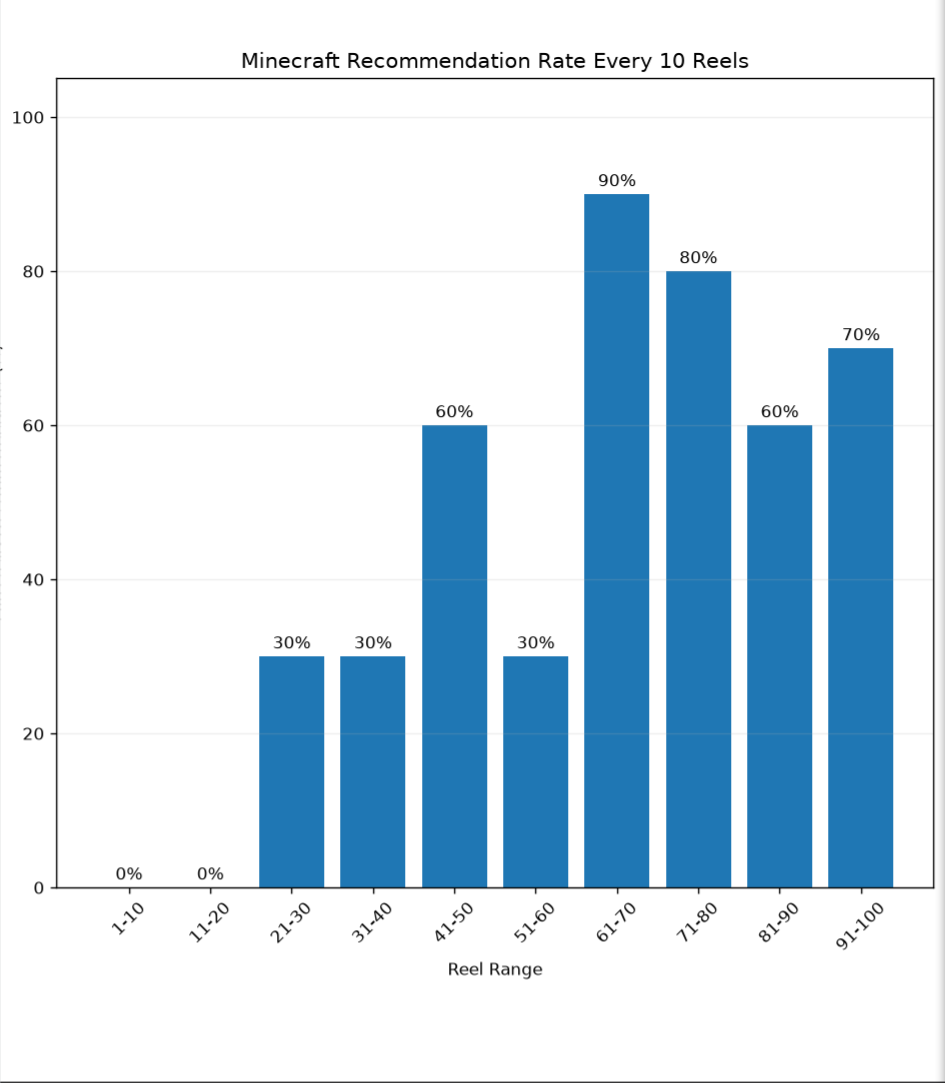
I conducted a simple experiment on 100 Reels. In this experiment, I pretended that I was a Minecraft watcher, after 9th reel I only searched term Minecraft and then continued browsing, but the account I was using had never searched for Minecraft and had never played any PC games.
See the graph and notice how consistent the recommendations became as I watched more Reels related to Minecraft.
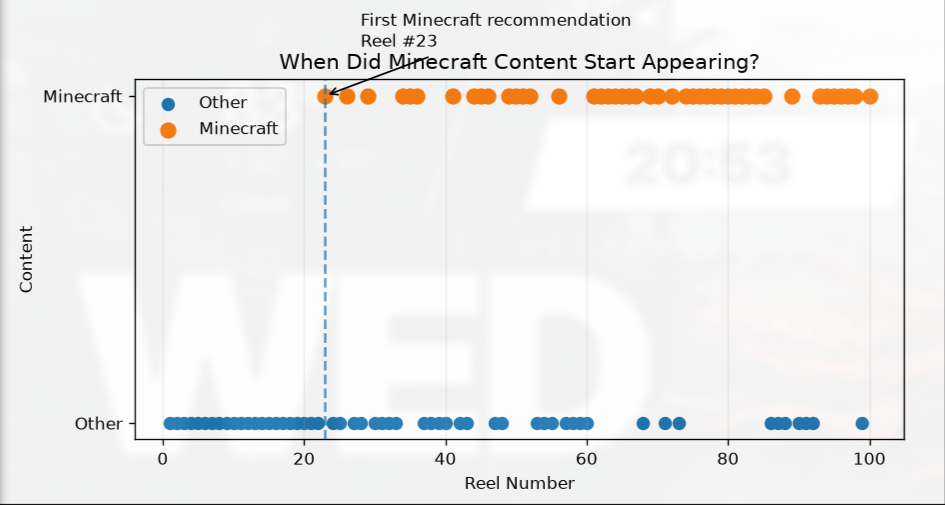
Did you notice how consistent the recommendations started becoming?
After 21th full watch the share of minecraft jumped from 30%-69%
The graph shows a positive relationship between watch completion and Minecraft recommendations. Users who watch more of a Reel are generally more likely to receive Minecraft-related recommendations. However, the recommendation rate is not identical to the completion rate, suggesting that watch behavior is one factor influencing recommendations rather than the only factor.
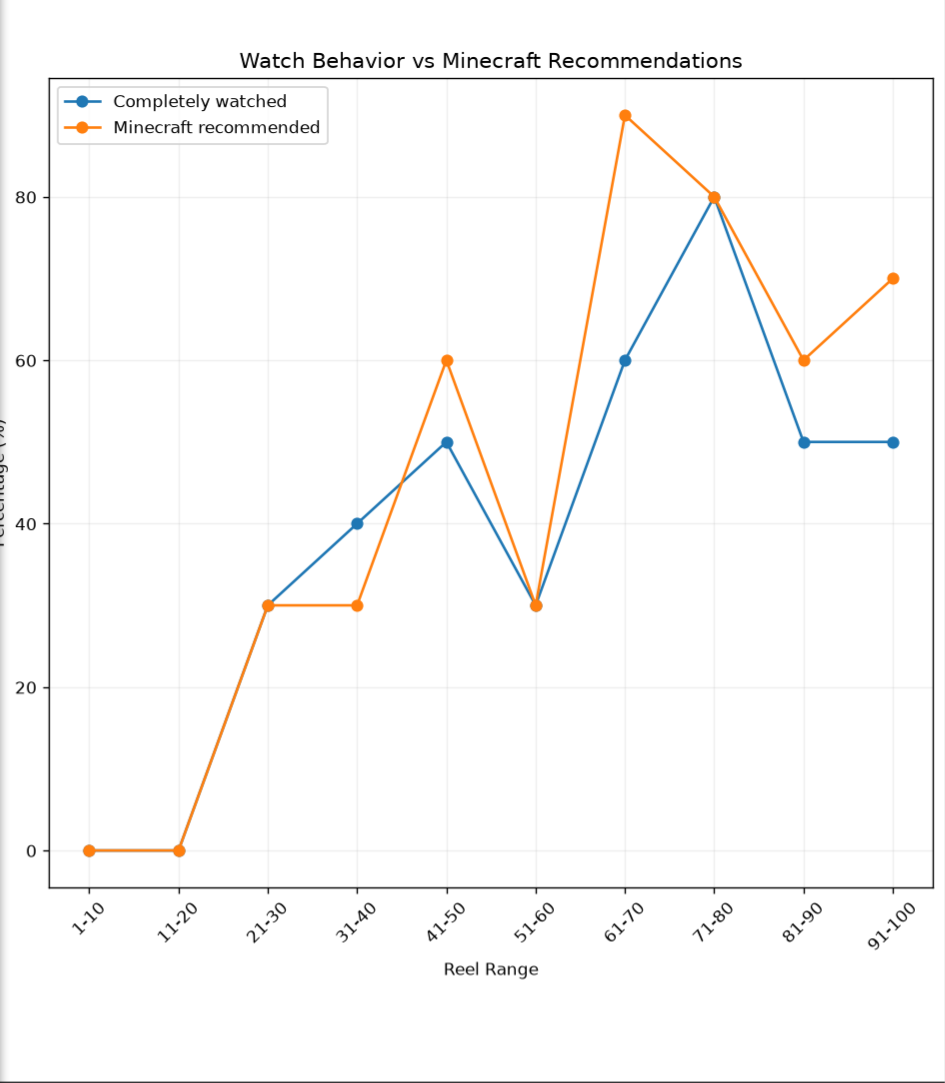
- I am not saying that Instagram is addictive. I am just trying to show how quickly Instagram adapts to a change in your behavior.
- You might think that if you don’t like, comment, or follow, then you are unpredictable to the algorithm. But the algorithm doesn’t need those actions. It can judge your interests based on your behavior.
How I Avoided These Things
Seeing firsthand how aggressively this algorithm adopts made me realize how easily it can hijack our attention. Here is how I actively broke that loop when my 12th class ended, I had too much free time, but I wasted it on YouTube Shorts. I also watched too many YouTube videos about how short-form content reduces your attention span, how big tech companies play with your brain, how they influence you, and how your valuable time is money for them.
Even a single notification is enough to drain your whole day.
The first thing I tried was using time limits to block apps, but I noticed that you can’t really limit something just by time. Then I tried changing the position of the apps so that the muscle memory would break.
It still didn’t work because once you open the app, you just scroll, scroll, and scroll.
Then I found a feature in YouTube ReVanced. At that time, I hadn’t even created an Instagram account. It allowed me to block the YouTube Shorts tab, and when I opened a Short, it would open in the regular player instead.
Over time, I gradually stopped wasting time on short-form content and shifted towards long-form content.
Now, about 2 months ago, I wanted to use Instagram to talk to people, but I knew how Instagram could play with my brain again. So I used an app to block each and every distracting feature. I only use Instagram to chat with people, and when I have to upload a video or something, I just upload it and move on to something productive.
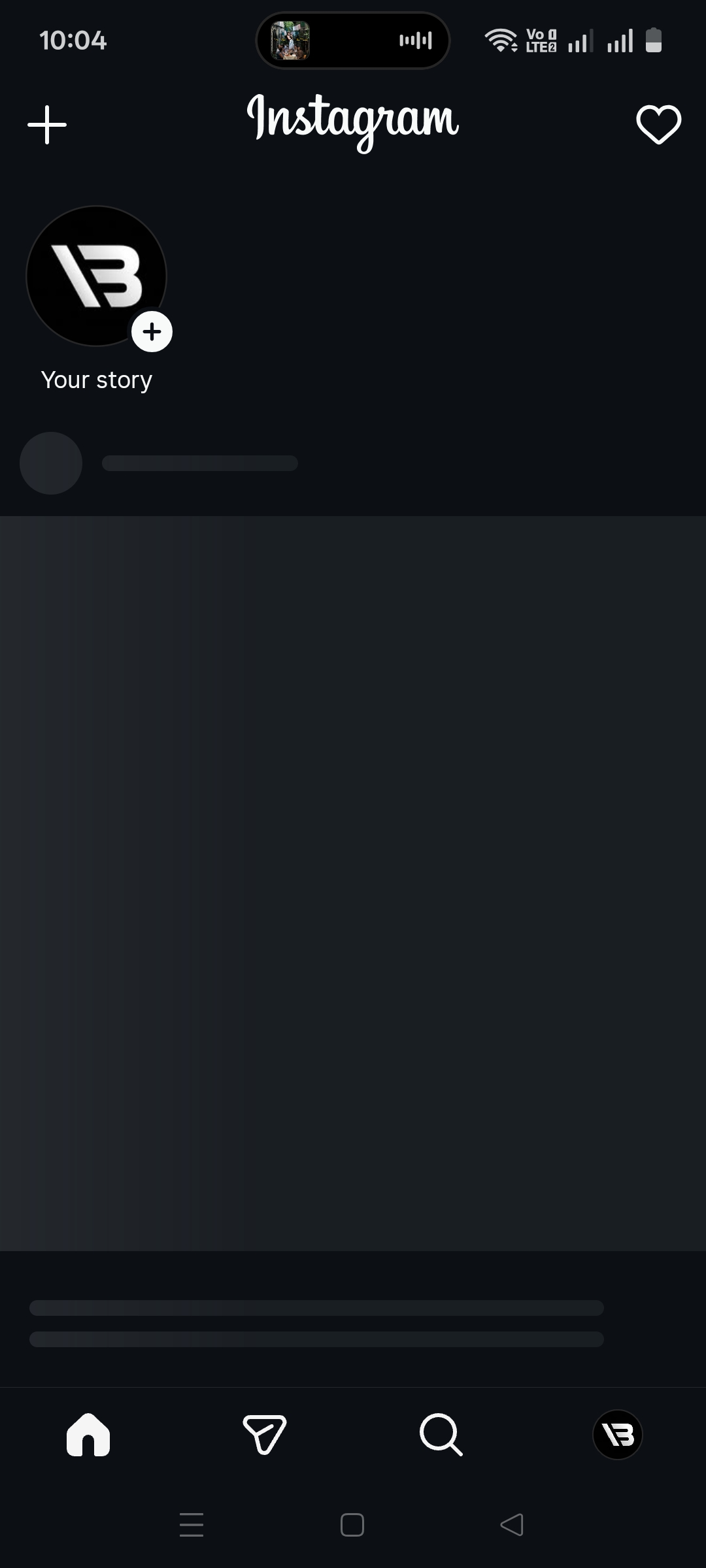
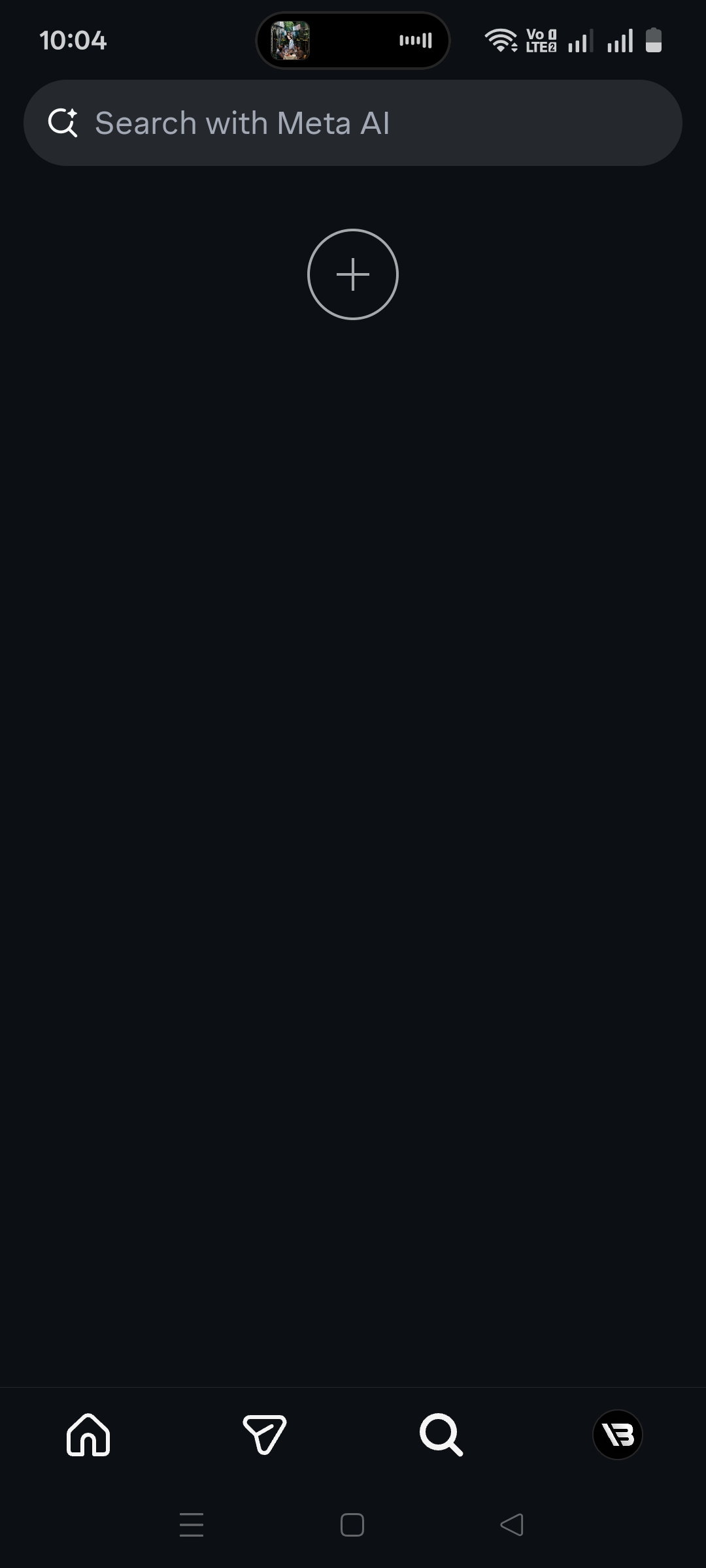
It never gonna load :]
I also blocked every app notification. Now I can sleep with my internet turned on without worrying about notifications.
At night, I used to use my phone, which completely messed up my sleep cycle. So I tried to replace it with reading books. I started with a novel that was around 100 pages.
Closing
The algorithm does not need your explicit approval. It only needs your eyes. Watch time is the signal, and the system is very good at reading it.
If you understand that, you can decide whether to feed the loop or break it. Most people never notice the difference.
Quote of the day:
An ambitious, paradoxical world we live in -
of short attention spans
paired with the massive fear
of being forgotten too soon.”
― Sreesha Divakaran, [Wine, Fire, Satin, Dew]